
Ph.D. Student
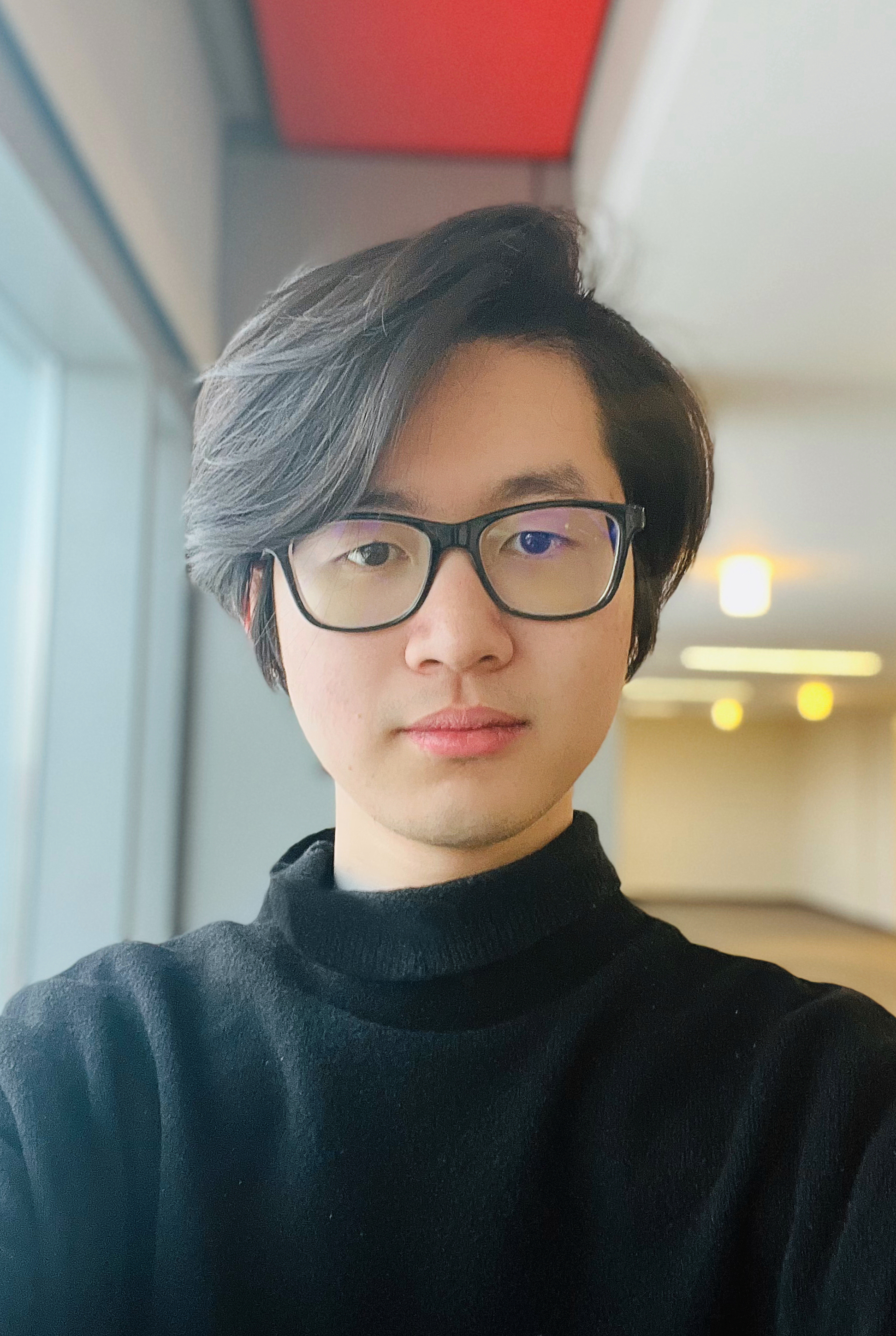
Board MemberI am a Ph.D. student at McGill University and Mila – Quebec AI Institute, co-advised by Prof. Doina Precup and Prof. Xiao-Wen Chang. My research focuses on continual reinforcement learning, aiming to develop AI systems that can learn and adapt in non-stationary environments. I am also a Board Member of ContinualAI, a nonprofit organization advancing research in continual learning. I co-organize the Mila Tea Talk, a weekly seminar series at Mila.
Previously, I completed my M.Sc. in Electrical and Computer Engineering at McGill and Mila, under the supervision of Prof. Narges Armanfard and Prof. Samira Ebrahimi Kahou, where I worked on anomaly detection. I also hold a B.Sc. in Electrical and Computer Engineering, with a Minor in Mathematics, from the University of Alberta.
") does not match the recommended repository name for your site ("").
", so that your site can be accessed directly at "http://".
However, if the current repository name is intended, you can ignore this message by removing "{% include widgets/debug_repo_name.html %}" in index.html.
",
which does not match the baseurl ("") configured in _config.yml.
baseurl in _config.yml to "".

Wesley Chung*, Zihan Wang*, Xiao-Wen Chang, David Meger, Doina Precup (* equal contribution)
Continual RL Workshop, Reinforcement Learning Conference (RLC) 2026
Continual reinforcement learning considers an agent that receives and learns from a stream of experience, aiming to maximize its accumulated reward. A fundamental problem is to evaluate such an agent using only its stream of experience, without assuming a particular structure of the world. We define an examiner that observes the same stream and, at every timestep, computes a perceived regret representing the agent's suboptimality gap from the examiner's perspective. We demonstrate empirically that perceived regret is a useful performance measure applicable to arbitrary streams of experience, and prove that no universal examiner can accurately assess all agents in any world, though specific modeling biases enable success in associated environments.
Wesley Chung*, Zihan Wang*, Xiao-Wen Chang, David Meger, Doina Precup (* equal contribution)
Continual RL Workshop, Reinforcement Learning Conference (RLC) 2026
Continual reinforcement learning considers an agent that receives and learns from a stream of experience, aiming to maximize its accumulated reward. A fundamental problem is to evaluate such an agent using only its stream of experience, without assuming a particular structure of the world. We define an examiner that observes the same stream and, at every timestep, computes a perceived regret representing the agent's suboptimality gap from the examiner's perspective. We demonstrate empirically that perceived regret is a useful performance measure applicable to arbitrary streams of experience, and prove that no universal examiner can accurately assess all agents in any world, though specific modeling biases enable success in associated environments.

Zihan Wang, Anita Slominska, Rennie Bimman, Elizabeth Di Flumeri, Amanda Mayappo-Neeposh, Conall Francoeur, Tamara Ellen Carver, Xiao-Wen Chang, Doina Precup, Esin Darici Haritaoglu, Ismail Haritaoglu, Akshatha Arodi, Naomi Goloff
Under review at EMNLP 2026
Pediatric serious illness communication (SIC) is critically important, yet scalable communication training for clinicians remains limited. Compared with other dialogue simulation settings, pediatric SIC poses additional challenges, including multi-party interactions, response to parental distress, and strong dependence on feedback dynamics. In collaboration with educators and pediatric clinicians, we introduce the first benchmark suite and simulation framework tailored to pediatric SIC training. Our benchmarks, PitfallBench and DialogueBench, evaluate simulators both at the turn level and across full dialogues. We further propose SIC-Agents, a self-improving framework that generates a clinician-editable skill document to guide simulator behavior. Our experiments show that SIC-Agents outperforms static expert prompting. To support future research, we release our benchmarks and a training interface for parent simulation in pediatric SIC.
Zihan Wang, Anita Slominska, Rennie Bimman, Elizabeth Di Flumeri, Amanda Mayappo-Neeposh, Conall Francoeur, Tamara Ellen Carver, Xiao-Wen Chang, Doina Precup, Esin Darici Haritaoglu, Ismail Haritaoglu, Akshatha Arodi, Naomi Goloff
Under review at EMNLP 2026
Pediatric serious illness communication (SIC) is critically important, yet scalable communication training for clinicians remains limited. Compared with other dialogue simulation settings, pediatric SIC poses additional challenges, including multi-party interactions, response to parental distress, and strong dependence on feedback dynamics. In collaboration with educators and pediatric clinicians, we introduce the first benchmark suite and simulation framework tailored to pediatric SIC training. Our benchmarks, PitfallBench and DialogueBench, evaluate simulators both at the turn level and across full dialogues. We further propose SIC-Agents, a self-improving framework that generates a clinician-editable skill document to guide simulator behavior. Our experiments show that SIC-Agents outperforms static expert prompting. To support future research, we release our benchmarks and a training interface for parent simulation in pediatric SIC.

Zihan Wang, Samira Ebrahimi Kahou, Narges Armanfard
Proceedings of the British Machine Vision Conference (BMVC) 2025 Oral
Zero-shot anomaly detection (ZSAD) aims to identify and localize unseen defects without requiring any labeled anomalies, but existing methods struggle to generalize under domain shifts. We propose PILOT, a framework combining a dual-branch prompt learning mechanism with label-free test-time adaptation, enabling dynamic adaptation to new distributions using only unlabeled data. PILOT achieves state-of-the-art performance on 13 industrial and medical benchmarks for both anomaly detection and localization under domain shift.
Zihan Wang, Samira Ebrahimi Kahou, Narges Armanfard
Proceedings of the British Machine Vision Conference (BMVC) 2025 Oral
Zero-shot anomaly detection (ZSAD) aims to identify and localize unseen defects without requiring any labeled anomalies, but existing methods struggle to generalize under domain shifts. We propose PILOT, a framework combining a dual-branch prompt learning mechanism with label-free test-time adaptation, enabling dynamic adaptation to new distributions using only unlabeled data. PILOT achieves state-of-the-art performance on 13 industrial and medical benchmarks for both anomaly detection and localization under domain shift.

Zihan Wang, Ruimin Chen, Mengxuan Liu, Guanfang Dong, Anup Basu
International Conference on Smart Multimedia 2022
We propose SPGNet, a method for 3D human pose estimation that integrates multi-dimensional re-projection into supervised learning. Our approach enforces kinematic constraints and jointly optimizes both 2D and 3D pose consistency, leading to improved accuracy. Experiments on the Human3.6M dataset show that SPGNet outperforms many state-of-the-art methods.
Zihan Wang, Ruimin Chen, Mengxuan Liu, Guanfang Dong, Anup Basu
International Conference on Smart Multimedia 2022
We propose SPGNet, a method for 3D human pose estimation that integrates multi-dimensional re-projection into supervised learning. Our approach enforces kinematic constraints and jointly optimizes both 2D and 3D pose consistency, leading to improved accuracy. Experiments on the Human3.6M dataset show that SPGNet outperforms many state-of-the-art methods.